

Feds defence plan, Ukraine war, renews talk on CAF robotics
Fri, 13th Mar 2026
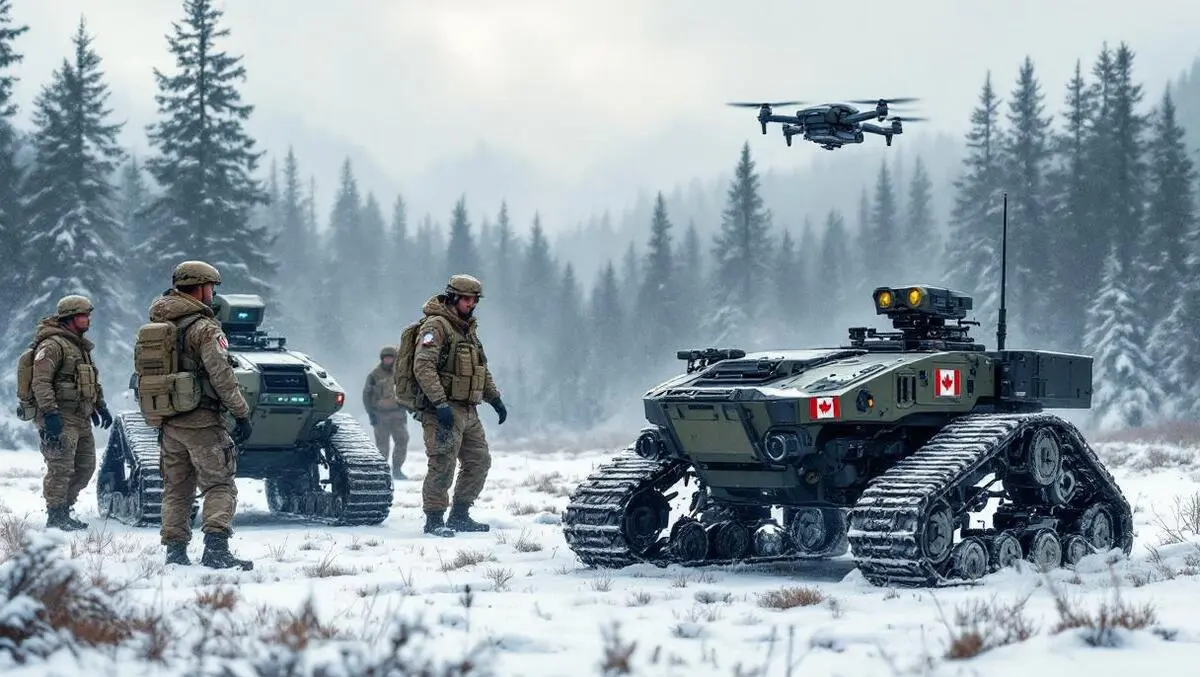
In February, the Canadian Armed Forces quietly signalled a turning point: Robotic and Autonomous Systems (RAS) are "no longer a niche capability" but "a core component of modern land operations."
According to an article in the Canadian Armed Forces publication The Maple Leaf, the Canadian Army Doctrine's new addition (Note 24‑04 on RAS), accessible only to authorised personnel, is pitched as a practical guide, complete with vignettes from current conflicts, a mission‑planning checklist, and standardised control measures for integrating robots into joint operations.
The new addition defines RAS broadly, from uncrewed aerial systems to ground vehicles and underwater platforms, and ties them explicitly to all operational functions - sensing, striking, shielding, sustaining and command.
Ryan Gariepy, founder of the Canadian Robotics Council, says robotics can help a smaller country maintain a credible defence posture while learning from global conflicts.
Gariepy points to the conflict in Ukraine as a clear example of how robotics is transforming warfare. Drones and other robotic systems have been responsible for the majority of recent battlefield strikes, demonstrating both offensive and defensive utility.
Ukraine has a vibrant tech sector, prior to the war, a piece of which switched innovation efforts to cheap, effective defence drones once attacks from Russia engulfed the nation.
Georgetown University ran a study on the effectiveness of drone tactics in modern defence, specifically in Ukraine. The study found that in 2024, Ukraine manufactured 2.2 million First Point View drones, compared to 600,000 the year prior. In 2024, the Ukrainian Armed Forces executed 130 long-range operations, resulting in hits on 377 key infrastructure targets in Russia.
In March 2025, UAF Commander-in-Chief Oleksandr Syrsky reported a 22 per cent increase in successful hits in February 2025 compared to the month prior, largely due to the effectiveness of these drones.
"We're seeing others learn in Ukraine or in the Gulf states right now, and take those lessons to heart and do them very quickly. The reason we're talking about this stuff in the robotics community, is because robotics is central to this in every modern nation," said Gariepy. "It's becoming central to military strategy, but it's also most important for the smaller countries, Canada being one of them."
He added that these systems are also being deployed in air defence, with drones challenging even well-resourced defence networks in the Gulf states. For smaller militaries, the ability to deploy robotics and to defend against them provides force multiplication and operational flexibility.
Last month's announcement of the country's Defence Industrial Strategy outlined robotics as a key player in the modern defence scene.
TechDay Canada reached out to the Department of National Defence for an interview on the use of drones in Canada's defence plan. They did not respond in time for publication.
"As the world has witnessed in Ukraine, drones are changing the nature of war. It is essential that Canada be a leader in drone and counter-drone research. To this end, the Government will establish a drone innovation hub at the NRC," stated the strategy. More detailed plans, which were announced earlier this week as part of a CAD $900 million investment for the National Research Council.
Robotic technology has come a long way since the Canadian Armed Forces trials of unmanned aerial systems (UAS) and bomb-disposal robots, with these systems mostly using allied or commercial platforms in niche roles (EOD, surveillance). Here are some key moments on the Canadian defence innovation timeline:
Afghanistan-era experiments
One of Canada's first serious exposures to unmanned systems came not through carefully planned procurement but via coalition operations in Afghanistan, where the CAF relied heavily on allied drones for surveillance and targeting.
The Joint Unmanned Surveillance and Target Acquisition System (JUSTAS) program, conceived to fill that gap, became a case study in drift. Around 2012, National Defence relaunched JUSTAS, forecasting multiple UAS "packages" with aircraft, satellite communications, control stations, training and 20‑year in‑service support.
The CAF renamed the project the Remotely Piloted Aircraft System (RPAS) in 2017.
Ground robots go from EOD tool to testbed
In 2014, the Department of National Defence signed contracts with iRobot, then best known for its Roomba vacuums, for 20 PackBot 510 CBRN Recce systems. The order was valued at roughly USD $9.6 million.
Configured with chemical, radiological, and explosive sensors, the tracked robots gave Canadian teams a way to detect hazards at stand‑off distances, rather than sending people in to do the job in heavy protective gear.
The long road to big drones
RPAS fleet is still on the horizon. In December 2023, Ottawa signed a roughly CAD $2.5‑billion contract to acquire 11 MQ‑9B drones, ground control stations, weapons, infrastructure and long‑term support for the RPAS project. The aircraft, a variant of the Reaper family, is being built at a U.S. facility in San Diego and is being modified for Arctic conditions.
The Department of National Defence has confirmed that operational testing will begin in 2026, with the first drone delivered in 2028. That date is already three years behind an initial 2025 target, delayed by technical changes for northern operations.
Full operational capability is expected between 2030 and 2033, according to a 2023 DND release.
"Canada must meet the growing demand for domestic assistance while preserving our ability to defend Canada, protect North America, and support our allies. This Remotely Piloted Aircraft System capability will provide Canadian Armed Forces members with nimble response options during deployed operations," said then Minister of National Defence Bill Blair regarding the announcement.
The drones are slated to operate from 14 Wing Greenwood in Nova Scotia and 19 Wing Comox in British Columbia, with a 6,000‑square‑metre control facility under construction in Ottawa's Uplands area to host six control stations, two simulators and nearly 200 personnel. That facility itself grew from a planned 4,000‑square‑metre footprint, a physical reflection of the project's expanded scope.